


Why LED High Bay Lights Are Extremely Popular in the United States
Rated:  , 0 Comments
, 0 Comments
Total hits: 5
Posted on: 08/13/26
Safety Standards & Mandatory Certifications for LED High Bay Lights in the United States
US safety rules for industrial LED high bays fall into 5 core categories:
- NRTL Electrical Safety Standards (mandatory for sale & installation)
- Hazardous Location Standards (for chemical/dust factories)
- EMC FCC Rules (smart/dimmable models)
- OSHA Workplace Lighting Safety Codes (facility operation compliance)
- Performance & environmental compliance (DLC, IES, IP/IK ratings)
1. Mandatory NRTL Electrical Safety Standards (UL / ETL Listed)
All LED high bay lights sold or installed in US commercial/industrial buildings must carry a Nationally Recognized Testing Laboratory (NRTL) mark (UL Listed or ETL Listed). Local electrical inspectors (AHJ) reject unmarked fixtures per NEC (National Electrical Code).
Core UL Standards
ANSI/UL 1598 – Luminaires (primary standard for all fixed high bay lights)
Covers all general electrical, mechanical, fire, thermal safety for ceiling/hook-mounted industrial lighting (≤600V US commercial voltage). Key test items:
- Electric shock protection: creepage distance, insulation, ground bonding
- Thermal cycling & abnormal overheat testing (no fire risk if driver fails)
- Dielectric voltage withstand (1000V + 2× rated voltage, no breakdown)
- Mechanical impact, vibration resistance (forklift collision safety)
- Ingress protection (dust/water IP rating validation)
- Fire resistance of plastic housings, wiring, terminal blocks
- Clear permanent labeling: wattage, voltage, temperature rating, mounting instructions
UL 8750 – LED Equipment for Lighting Products
Compulsory supplementary standard for all LED modules, LED drivers, power supplies inside high bays:
- Safety of constant-current LED drivers (overvoltage, short-circuit protection)
- Thermal limits for LED chips, PCB boards
- Separation between low-voltage LED circuits and 120/480V mains power
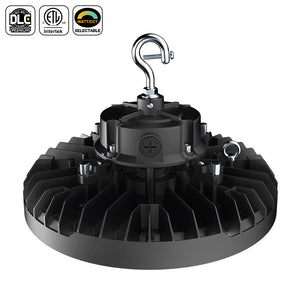
Alternative Equivalent Certification: ETL Listed
ETL follows identical UL 1598 / UL 8750 standards and is fully accepted by US electrical codes, retailers (Amazon, Home Depot) and inspectors.
2. Hazardous Location Safety Standard: UL 844
For high bays used in risky industrial sites (chemical plants, grain mills, paint booths, refineries), UL 844 Luminaires for Hazardous Locations is required instead of standard UL1598: Class divisions defined by hazard type:
- Class I: Flammable gas/vapor (fuel, solvents) → Division 1/2
- Class II: Combustible dust (flour, aluminum, wood dust)
- Class III: Ignitable textile fibers These fixtures are sealed, explosion-proof, spark-contained to prevent ignition of flammable atmospheres.
3. FCC Part 15 Subpart B – Electromagnetic Compatibility (EMI)
Mandatory for any LED high bay with: 0–10V dimming, motion sensors, Wi-Fi/Bluetooth smart controls, wireless networking. Rules limit radio frequency interference that disrupts factory PLCs, forklift radios, warehouse scanners. Non-compliant fixtures cannot be imported or sold in the US.
4. OSHA Workplace Lighting Safety Regulations (29 CFR)
OSHA does not certify lights themselves, but enforces legal safety rules for facilities using high bay lighting; violations carry fines up to $16,550 per serious infraction.
Key OSHA Lighting Requirements
- Minimum Illumination Levels (foot-candles, fc
| Workplace Zone | OSHA Minimum FC |
|---|---|
| General warehouse storage aisles | 5 fc |
| General manufacturing/factory floor | 10 fc |
| Assembly, inspection, picking stations | 30–50 fc |
| First aid rooms | 30 fc |
| Construction yards | 3–5 fc |
- Uniform, glare-free lighting No extreme shadows that hide trip/collision hazards; high-CRI LED light required for color-coded inventory & quality inspection.
- Mounting structural safety (OSHA 1926.753) Mount brackets, chains, ceiling supports must have a 5:1 safety load factor (support 5× the fixture weight) to prevent falling lights onto staff or forklifts.
- Emergency egress lighting All industrial buildings need backup lighting for exit routes during power failure.
- Toxic material elimination LEDs contain no mercury (unlike metal halide HID), eliminating OSHA hazardous waste disposal liability for broken lamps.
5. Voluntary but Industry-Mandated Performance & Safety Standards
DLC (DesignLights Consortium) Qualified / DLC Premium
Not federal law, but required by nearly all US utility rebate programs, commercial construction bids, and energy incentives.
- Tests photometric safety: consistent lumen output, low flicker (flicker causes eye strain & workplace accidents)
- Verifies long-term LED lifespan (LM-80 / TM-21 standards)
- Ensures no dangerous blue-light overexposure for 12–24hr shift workers DLC Premium enforces stricter efficiency and light quality, qualifying for larger cash rebates per fixture.
IES Photometric Standards (LM-79, LM-80, TM-21)
Industry safety benchmarks referenced by UL, DLC, Energy Star:
- LM-79: Standardized lumen, color, flicker testing
- LM-80: Long-term LED chip lumen depreciation testing
- TM-21: Projected 50,000–100,000hr service life prediction
IP & IK Environmental Safety Ratings
Required spec for industrial wet/dirty warehouses:
- IP65 / IP66: Dust-tight, water splash resistant (standard for warehouse high bays)
- IK08 / IK10: High mechanical impact resistance (forklift, pallet collision protection)
Energy Star (EPA + DOE)
Voluntary but widely specified for government and corporate ESG building projects; builds on UL 1598 safety baseline plus strict energy efficiency rules.
6. National Electrical Code (NEC) Installation Safety Rules
US electricians must install LED high bays following NEC Article 410 (Luminaires):
- Proper grounding of all metal fixture housings
- Overcurrent protection for high-power 200–400W high bays
- Clearance rules between hot fixture surfaces and flammable ceiling materials
- Wiring limits for 480V three-phase industrial factory power
Quick Compliance Summary for US Market Entry
- Must-have: UL1598 + UL8750 (UL/ETL Listed)
- Smart/dimmable models add: FCC Part 15B
- Hazardous sites upgrade to: UL 844
- Rebate eligibility: DLC Qualified
- Facility operation: Meet OSHA 29 CFR illumination & mounting safety rules
- Installation: Follow NEC Article 410 electrical code
Specific FCC EMC Rules for LED High Bay Lights Sold in the US
All LED high bay lights rely on switching LED drivers that generate RF noise above 9kHz, so they are regulated under FCC Title 47 CFR Part 15 (Radio Frequency Devices). The exact rules split into two product categories: standard non-wireless high bays and smart wireless high bays.
1. Core Mandatory Rule: FCC Part 15 Subpart B (Unintentional Radiators)
This applies to all regular LED high bay lights (UFO, linear, 0–10V dimmable, PIR motion sensor models with no Wi‑Fi/Bluetooth/Zigbee).
Legal Definition
LED high bays are classified as unintentional radiators: they produce RF interference as a side effect of their switching power drivers, not for wireless communication.
Key Mandatory Test Items (per ANSI C63.4 test method)
- Conducted Emissions (CE)
- Frequency range: 150 kHz – 30 MHz
- Measures noise leaking back through AC power lines that disrupt factory PLCs, barcode scanners, forklift radios, or building control systems.
- Two limit classes defined by usage environment:
- Class A (Industrial / Commercial): Mandatory for warehouse/factory high bays; looser emission limits, allowed only for non-residential installations (the standard for nearly all US high bay lights).
- Class B (Residential): Far stricter limits, only required if the high bay is marketed for garages, home workshops, or retail consumer sale to private households.
- Radiated Emissions (RE)
- Frequency range: 30 MHz – 1000 MHz
- Measures RF noise radiating through the air from the fixture housing, driver PCB, and wiring harnessFederal Co....
Compliance Authorization: SDoC (Supplier’s Declaration of Conformity)
For non-wireless LED high bays, there is no FCC ID required:
- Manufacturers/importers complete EMC testing at an accredited lab, issue an internal SDoC declaration, and keep test records on file for FCC inspection.
- No formal FCC certificate application is needed, but all import shipments must have valid test reports to clear US customs.
Mandatory Labeling Rule
Every compliant fixture must carry a permanent FCC label stating:
This device complies with Part 15 of the FCC Rules. Operation is subject to the following two conditions: (1) this device may not cause harmful interference, and (2) this device must accept any interference received, including interference that may cause undesired operation.
2. Additional FCC Rules for Smart Wireless LED High Bays
If a high bay integrates Wi‑Fi, Bluetooth, Zigbee, LoRa, or other wireless modules for remote control/app connection, two extra FCC sections apply:
FCC Part 15 Subpart C / E (Intentional Radiators)
The wireless radio module is an intentional RF transmitter and requires full FCC ID Certification:
- Testing covers RF transmit power, spurious emissions, frequency tolerance, and adjacent-channel interference.
- A TCB (Telecommunications Certification Body) reviews test data and issues a unique FCC ID number printed on the fixture label.
- The base LED driver still must also pass Part 15B Class A EMC testing for power supply noise (dual compliance requirement).
FCC KDB Publication 640677 (Official Lighting Guidance)
This FCC technical bulletin clarifies special EMC rules unique to LED luminaires:
- All LED drivers operating above 9 kHz are automatically subject to Part 15B, regardless of wattage (covers 100W–500W industrial high bays).
- Expanded radiated emission testing up to 1 GHz is required even if the LED chip switching frequency is below 30 MHz.
- Dimming circuits (0–10V, DALI, PWM) do not exempt fixtures from full CE/RE testing; dimming amplifies RF noise and requires extra filtering validation.
3. What about FCC Part 18? Rare Exception
FCC Part 18 governs ISM (Industrial, Scientific, Medical) RF equipment. Standard LED high bays do NOT fall under Part 18. Only specialized RF-excited lighting (rare legacy HID ballasts, plasma lights) uses Part 18; modern LED high bays always follow Part 15B.
4. Critical Enforcement & Industrial Consequences of Non-Compliance
- US Customs can seize non-FCC-compliant high bay shipments at ports.
- Electrical inspectors (AHJs) reject fixture installation permits for unlabeled, non-compliant lights.
- FCC fines for violating Part 15 range from $10,000 to $144,344 per product model.
- Interference violations: If LED high bay noise disrupts factory radio systems, the facility owner is legally required to shut off the lights until interference is resolved (§15.5 FCC rule)Federal Co....
5. Industry-Specific Design EMC Rules for High Bay Drivers (De Facto Standard)
While not written FCC regulation, US industrial buyers enforce these EMC-related specs to pass Part 15 Class A easily:
- Power Factor ≥0.9 and THD <20% (reduces low-frequency line noise).
- Built-in AC EMI filters on driver input terminals.
- Metal UFO/aluminum linear housings act as RF shielding to cut radiated emissions.
- Surge protection (4kV–6kV) to avoid transient RF spikes triggering EMC test failures.
Why LED High Bay Lights Are Extremely Popular in the United States
LED high bay lights dominate U.S. industrial, warehouse, logistics, manufacturing and large retail spaces, replacing outdated metal halide (MH), high-pressure sodium (HPS) and fluorescent fixtures. Their massive popularity stems from economic savings, U.S. policy incentives, superior performance, safety compliance, compatibility with American industrial infrastructure and modern smart warehouse trends.
1. Dramatic Long-Term Energy Cost Savings (Top Driver)
American industrial facilities run lighting 12–24 hours daily across vast square footage, making electricity one of the biggest overhead expenses.
- LEDs cut lighting power consumption by 50%–75%: A 150W LED high bay fully replaces a 400W metal halide fixture with equal or brighter illumination.
- High luminous efficiency (170–200 lm/W): Traditional HID lights waste 70–80% energy as heat, while LEDs convert ~80% of electricity into usable light.
- Less heat output reduces warehouse/factory air conditioning loads, creating secondary cooling cost savings, especially in hot southern U.S. states.
- At U.S. commercial electricity prices (~$0.12–$0.15/kWh), most retrofit projects hit full payback within 1–2 years before rebates.
2. Near-Zero Maintenance, Eliminating Expensive High-Ceiling Repairs
U.S. warehouses and factories often have 20–40 ft ceilings, so lamp replacement requires costly cherry pickers, scaffolding and production downtime.
- LED lifespan: 50,000–100,000 hours (5–10× longer than 10,000-hour metal halide lamps). Facilities only replace fixtures every 5–8 years instead of every 1–2 years.
- No frequent ballast failures, flickering or mercury-laden broken HID bulbs (classified hazardous waste requiring regulated disposal in the U.S.).
- Real-world case data shows annual lighting maintenance costs drop from over $12,000 to under $1,000 after switching to LED high bays.
3. Generous U.S. Utility & Federal Financial Incentives
Nearly all U.S. states offer strong financial programs that erase the higher upfront fixture cost, the only historical downside of LEDs:
- Utility rebates: 78% of U.S. utility territories provide cash rebates per DLC-qualified LED high bay fixture ($50–$300 each). Extra bonuses apply for fixtures with motion/daylight sensors.
- Federal tax incentives: Commercial energy efficiency upgrades qualify for accelerated depreciation and tax deductions under U.S. IRS energy codes.
- DLC certification standard: Most U.S. rebate programs only accept DLC-listed LED high bays, creating a standardized, widely available product supply chain across American electrical distributorsXcel Energ....
- State energy efficiency programs (Mass Save, Xcel Energy, NYSEG, etc.) offer instant point-of-purchase discounts for business owners.
4. Superior Light Quality & Operational Productivity for U.S. Logistics
America’s booming e-commerce fulfillment centers, automated warehouses and manufacturing plants demand precise, reliable lighting:
- Instant full brightness: No multi-minute warm-up or hot restrike delay after power outages (a major flaw of metal halide). Critical for 24/7 shift operations and emergency power recovery.
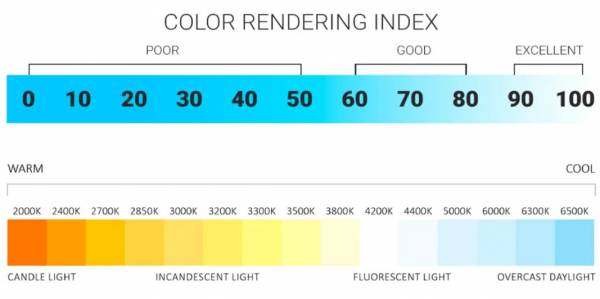
- High Color Rendering Index (CRI ≥80): Yellow-toned HPS lights (CRI 20–30) cause picking errors and quality defects. LED neutral white light (4000K–5000K) lets staff read labels, distinguish color-coded inventory and inspect manufactured goods accurately.
- Uniform, flicker-free illumination reduces eye strain for forklift operators and assembly line workers.
5. Full Compatibility with U.S. Industrial Electrical Infrastructure
Most U.S. factories, distribution hubs and heavy industry run on 480V three-phase power systems. LED high bays are widely engineered for both 120V and 480V U.S. standard voltages, simplifying new construction and retrofits without costly wiring overhauls. Two mainstream designs fit all American facility layouts:
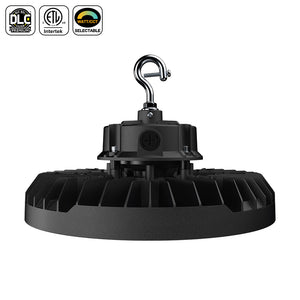
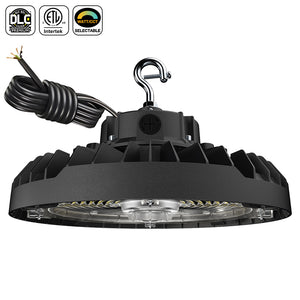
- UFO round high bays: Dominant for open warehouse storage floors, simple hook mounting.
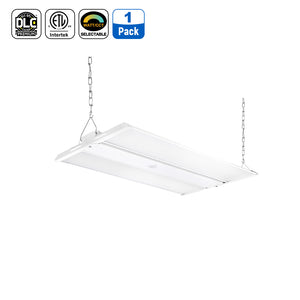
- Linear LED high bays: Ideal for narrow rack aisles, assembly lines and big-box retail interiors.
6. OSHA Workplace Safety Compliance (Avoid Heavy U.S. Penalties)
OSHA enforces strict minimum illumination rules for industrial workspaces, with fines up to $16,550 per safety violation, plus daily cumulative penalties for non-compliance:
- LED high bays deliver consistent, bright foot-candle levels meeting OSHA 29 CFR standards (5 fc minimum for storage aisles, 30–100 fc for assembly/quality inspection zones).
- Brighter, even lighting eliminates shadowed hazards: Reduces forklift collisions, trip risks and workplace injury claims, a top priority for U.S. facility risk management teams.
- No toxic mercury content in LEDs removes hazardous material liability compared to HID lamps.
7. Built-In Smart Lighting Controls for U.S. Automated Warehouses
The U.S. leads global warehouse automation (Amazon fulfillment, third-party logistics centers), and LED high bays natively support smart controls incompatible with traditional lighting:
- 0–10V dimming, occupancy/motion sensors, daylight harvesting and wireless networked lighting controls cut an additional 20–30% energy use during off-shifts or low-occupancy hours.
- Smart LED lighting integrates with warehouse management systems (WMS), a standard requirement for newly built U.S. logistics parks; over 72% of new American distribution centers install LED high bays from construction phase.
https://bit.ly/fms-vier-90mm-jet
8. Favorable U.S. Energy & Environmental Policies
- U.S. Department of Energy (DOE) efficiency standards phase out inefficient HID lighting, pushing industrial operators to upgrade to LEDs.
- Corporate ESG (Environmental, Social, Governance) reporting requirements for U.S. public companies prioritize energy-efficient lighting to lower carbon footprints; LED upgrades count toward sustainability targets.
- LED fixtures have long 5–10 year manufacturer warranties from U.S.-branded suppliers, with nationwide electrical contractor installation support, reducing project risk for business owners.
Summary of Core U.S. Market Drivers
- Unmatched energy & maintenance ROI, accelerated by utility cash rebates and tax breaks
- Low-upkeep design perfectly suited for America’s tall-ceiling industrial buildings
- OSHA safety compliance and reduced workplace accident liability
- Compatibility with 480V U.S. factory power and automated smart warehouse systems
- Better light quality cutting inventory and manufacturing errors for America’s massive logistics sector
- Federal/state efficiency regulations phasing out old, inefficient HID lighting technology.
Comments
There are still no comments posted ...
Rate and post your comment